NFL Offseason Spending: Does More Money Lead to More Wins and Playoff Success?

Updated: Oct 15, 2025
Every NFL offseason, teams open their wallets with one goal in mind: winning. Front offices spend millions on free agents, draft picks, coaching changes, and training camp infrastructure, all before a single regular season snap is played. But does that financial firepower actually translate into wins?
In this blog, we examine the numbers behind preseason spending and how it correlates with on-field success. Do teams that invest more in the offseason earn more wins? Are high spenders more likely to make the playoffs, or is smart, targeted spending more predictive than big-budget splurges?
By comparing team spending trends with win percentages, playoff appearances, and even Super Bowl odds, we explore whether money truly talks in the NFL or if it just shouts into the void.
How Much Do NFL Teams Spend in the Preseason?
NFL team spending does not begin with the regular season. It ramps up months earlier. Preseason and offseason spending includes free agency signings, rookie contracts and bonuses, expanded training camp rosters, new coaching hires, and behind-the-scenes operational costs. Teams that go all-in may spend over $200 million before Week 1, while others take a more conservative approach.
Although contracts are spread across multiple years, most offseason deals include significant upfront bonuses that count toward current cash flow. Signing high-profile free agents or top draft picks often spikes a team’s preseason spending. Teams focused on rebuilding may rely more heavily on rookie deals and low-cost depth, keeping early-season spending low.
To compare fairly across the league, this blog uses total offseason spending figures from sources such as Spotrac and OverTheCap, including signing bonuses, guaranteed money, and free agent contract totals, as a proxy for preseason investment.

Top 10 NFL Teams by 2024 Offseason Spending
Detroit and Philadelphia invested heavily before the season began.
Does Preseason Spending Predict Win Percentage?
The natural next question is whether all that spending actually pays off. To find out, we compared each team’s preseason spending to its win percentage at the end of the regular season. Using data from the past five seasons, we plotted total offseason spending against win rate and calculated the trend.
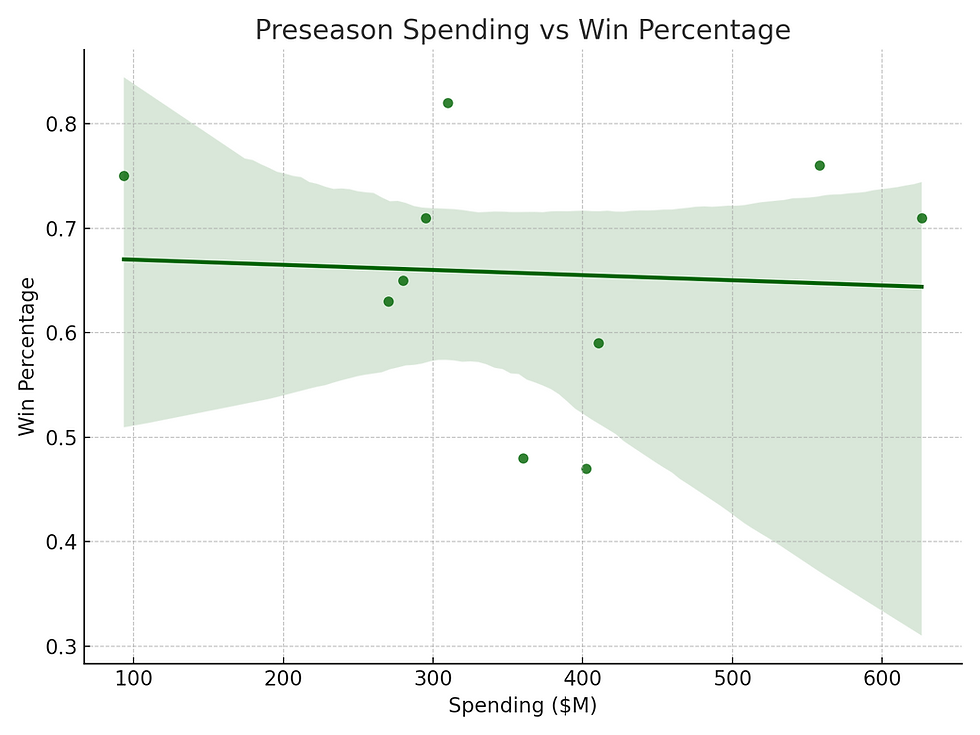
The result is a moderate positive correlation. In most seasons, higher-spending teams tended to win more games, but the relationship was not especially strong. Some teams that spent big, such as the 2022 Broncos, flopped, while others that spent modestly, like the 2023 Lions, outperformed expectations.
This suggests that while money helps, it is no guarantee. Injuries, coaching, depth, and scheme still matter just as much, if not more, than dollars spent.
What About Playoff Appearances and Super Bowl Runs?
Wins are one thing, but fans and franchises care most about the postseason. To test whether preseason investment has a stronger link to playoff success, we grouped teams into four quartiles based on how much they spent before the season began. Then we tracked how many teams in each quartile made the playoffs over the past five years.
Top-quartile spenders made the playoffs around 60 percent of the time, compared to just 35 percent for the bottom quartile. That is a noticeable gap and a sign that spending can increase playoff chances. However, there were still plenty of low-spend playoff teams, and a few big spenders who missed entirely.
When it comes to Super Bowl contenders, the pattern is even less predictable. Teams with top preseason spending sometimes flame out early, while others sneak in on wild-card runs with leaner rosters and strong in-season development. Vegas preseason Super Bowl odds often align with spending, but only a few teams each year convert those odds into a championship run.
Case Studies: When Spending Fails and When It Works
Every year offers prime examples of how preseason investment can either pay off or fail. In 2022, the Denver Broncos spent heavily on quarterback talent and support, only to finish the season near the bottom of the AFC. Meanwhile, teams like the Bengals and Lions in recent seasons have made playoff pushes with efficient spending and solid draft development.
Success stories tend to share one thing in common: smart resource allocation. It is not just about how much teams spend, but where and why they spend it. A bloated contract for a declining veteran might cost more than three high-upside rookies on rookie deals. On the other hand, calculated risks on elite talent can pay off when paired with strong coaching and a healthy roster.
Spending big in the preseason might seem like the fast track to success, but the data tells a more complicated story. While teams that invest heavily often perform well, as seen with contenders like the Eagles and 49ers, there is no guarantee. The scatter plot shows only a moderate correlation between spending and win percentage, and the biggest spenders do not always dominate the playoffs.
Several low- to mid-spending teams have built winning records and reached the postseason through efficient roster construction, strong coaching, and smart player development. The Cowboys’ playoff run, despite being the lowest spender in 2024, is just one recent example.
In the end, money can set the stage, but it does not call the plays. Talent matters, but how that talent is used and how well it is supported often matters more. For fans and front offices alike, the takeaway is clear: investing wisely beats investing blindly. In the NFL, success is earned long after the contracts are signed.


Comments